

What this routine does and what it does not do
If you often eat while rushing, tense, distracted, or still carrying stress from the day, you might notice patterns like eating too fast without realizing it, swallowing extra air, feeling uncomfortable during or after meals, not noticing fullness until it is too late, or stress eating even when you planned a real meal.
This guide is a simple solution you can use anywhere. It is not a long meditation or a perfect self care ritual. It is a practical micro routine that takes almost no time and stacks easily into real life. Think of it like washing your hands before cooking. It is a small action that makes the next step easier and cleaner.
- A 2 minute reset you do right before eating.
- A simple way to slow your first bites.
- A tool to reduce stress driven eating patterns.
- A habit that pairs well with gut friendly routines.
- A cure for IBS, GERD, bloating, or anxiety.
- A replacement for medical care.
- A requirement you must do perfectly.
- A complicated program with rules.
The idea in plain language
Your body has different “modes.” One mode supports urgency, alertness, and stress. One mode supports calming, recovery, and digestion.
You cannot force a perfect switch instantly, but you can nudge your system. Breathing is one of the simplest nudges because it is a direct lever you can control right now. For many people, a longer exhale helps the body feel safer and steadier. That steadier state often leads to slower eating, better chewing, and more awareness of hunger and fullness cues.
You do not need to understand the science to benefit. You only need a repeatable routine.
The 2 minute downshift before meals
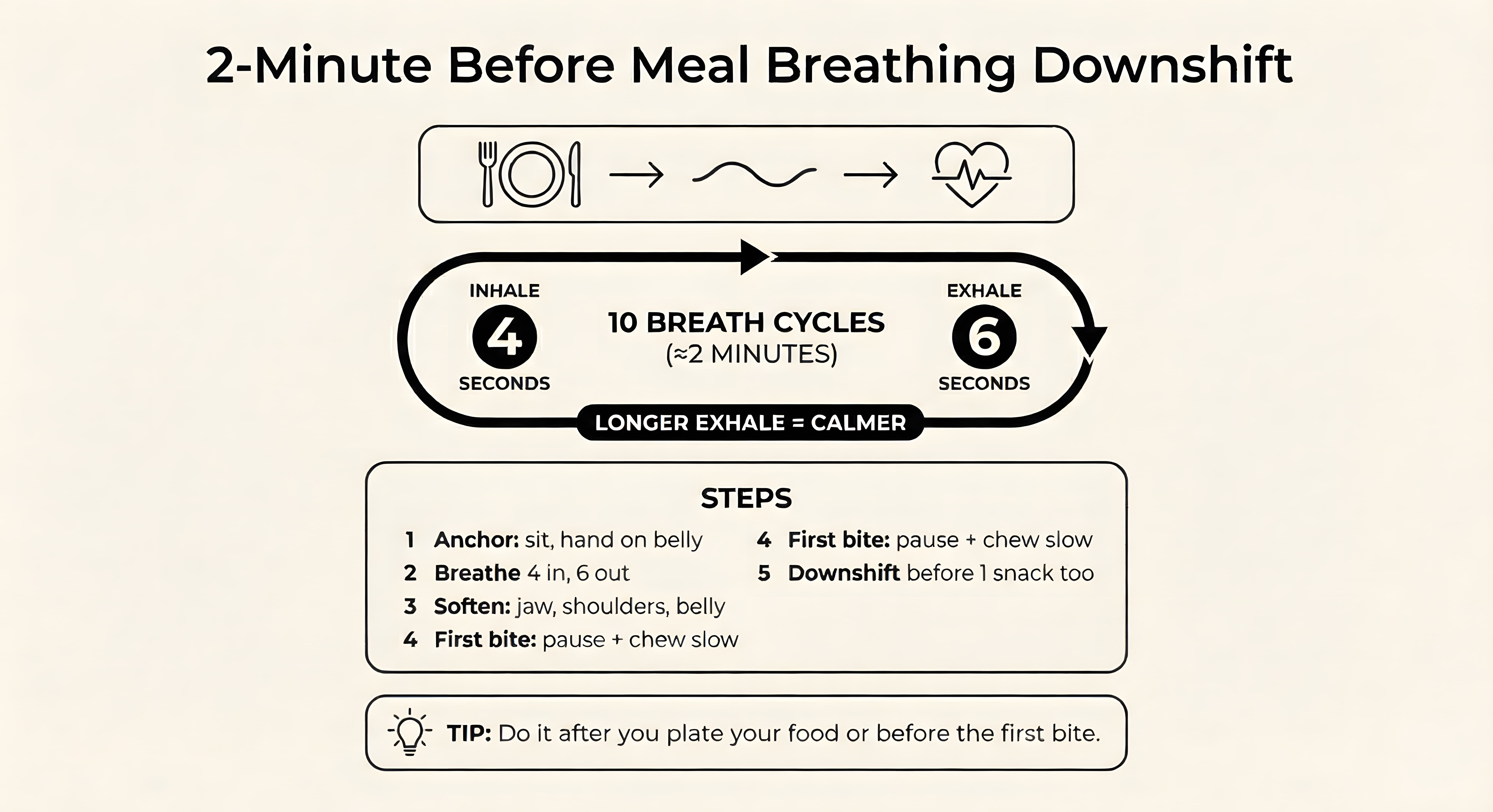
Core PracticeThis is the entire routine: Inhale for 4 seconds, exhale for 6 seconds, and repeat 10 cycles. That equals about 2 minutes. If a 6 second exhale feels too long, start with inhale 4 and exhale 5 for a few days. Then build up.
Step 1: Choose your anchor
Your anchor tells your brain, “We pause before we eat.” Pick one anchor and keep it the same each time. Consistency matters more than the “best” anchor.
- Feet flat on the floor
- One hand resting on your belly
- Hands resting on the table
- Shoulders relaxing down
- Soft gaze at your plate before touching utensils
Step 2: Gentle & quiet
You are not trying to take huge breaths. Big breaths can feel activating. Aim for a quiet inhale, smooth exhale, minimal shoulder movement, small belly expansion, and soft ribs expansion. If you can breathe through your nose comfortably, do that.
Count in your head. Inhale 2 3 4, Exhale 2 3 4 5 6. Repeat. If you lose count, it is fine. Come back to the next inhale and continue.
On each exhale, soften one area: Jaw, tongue, shoulders, belly, or hands. You are not forcing relaxation. You are inviting a small drop in tension.
Before the first bite, pause for one normal breath. Then take the first bite slowly and chew a little more than usual. This turns breathing into an eating shift.
The exact 2 minute script you can follow
Use this when you do not want to think. If you prefer, set a 2 minute timer and breathe with a longer exhale until the timer ends.
- Feet on the floor
- Hand on belly
- Inhale 2 3 4
- Exhale 2 3 4 5 6
- Jaw soft
- Inhale 2 3 4
- Exhale 2 3 4 5 6
- Shoulders drop
- Continue until 10 cycles
- One normal breath
- First bite slow
When to do it so it actually sticks
The best routine is the one you will do consistently. These triggers make it easy.
Trigger 1: Right after you plate
Put the plate down, sit, do the downshift, then eat.
Trigger 2: Before picking up fork
Works well if eating with others. Hands on table, soft gaze, longer exhale for 6-10 breaths, then eat.
Trigger 3: Before the first sip
If you start meals with a drink. Sit, downshift, sip, then eat.

If you want the strongest digestion tie in, start with one meal a day. Use your biggest meal. Do it daily for 7 days.
What changes people notice first
This is subtle, which is why it works. The goal is not perfect calm. The goal is a small shift that changes your pace.
- Less urgency to start eating.
- Less “shovel it in” energy.
- More chewing without forcing it.
- More awareness of hunger and fullness.
- More satisfaction from the same amount of food.
- Fewer stress driven bites while distracted.
Why slower eating helps in real life
Most people do not need complicated rules. They need a better pace.
A calmer start often leads to:
- More chewing
- Less rushed swallowing
- Less air gulping
- More awareness of the half full point
- More intentional stopping when satisfied
- Eat at your desk
- Eat while scrolling
- Eat while driving between tasks
- Eat “standing up in the kitchen”
- Stress snack when overwhelmed
Common mistakes that make it feel like it does nothing
If you have tried breathing exercises before and felt nothing, it is usually one of these.
Mistake 1: Breathing too big
Big breaths can feel activating. Fix: Make it smaller and quieter.
Mistake 2: Forcing the exhale
If you blow air out hard, you can feel tense. Fix: Make the exhale slow and gentle, like fogging a mirror softly.
Mistake 3: Shoulders rising
That turns breathing into effort. Fix: Keep shoulders heavy and relaxed.
Mistake 4: Doing it while scrolling
Your nervous system is still in input mode. Fix: Put the phone face down for two minutes.
Mistake 5: Skipping the first bite pause
Then the breathing does not influence how you eat. Fix: Always take one normal breath before the first bite.
How to tell it is working
Look for small body cues. Small signs are enough. This routine is about repeatability, not dramatic effects.
- Jaw unclenches
- Tongue relaxes
- A spontaneous sigh
- Shoulders drop
- Belly feels less tight
- You start eating with less urgency
- You naturally slow the first few bites
Quick variations for real life
You do not need a perfect routine. You need a reliable one.
The 60 second version
Inhale 3 seconds. Exhale 4 seconds. Repeat 8 cycles. One normal breath. First bite slow.
The "public dinner" version
Soft gaze at your plate. Longer exhale than inhale. No counting. About 6 to 10 breaths. Then eat.
The "high stress" version
If your body feels revved up, take one deeper inhale, exhale fully, then begin the 4 and 6 pattern.
If focusing on breath makes you anxious, skip this and use the 60 second version.
A simple 7 day starter plan
This is the fastest way to turn it into a real habit.
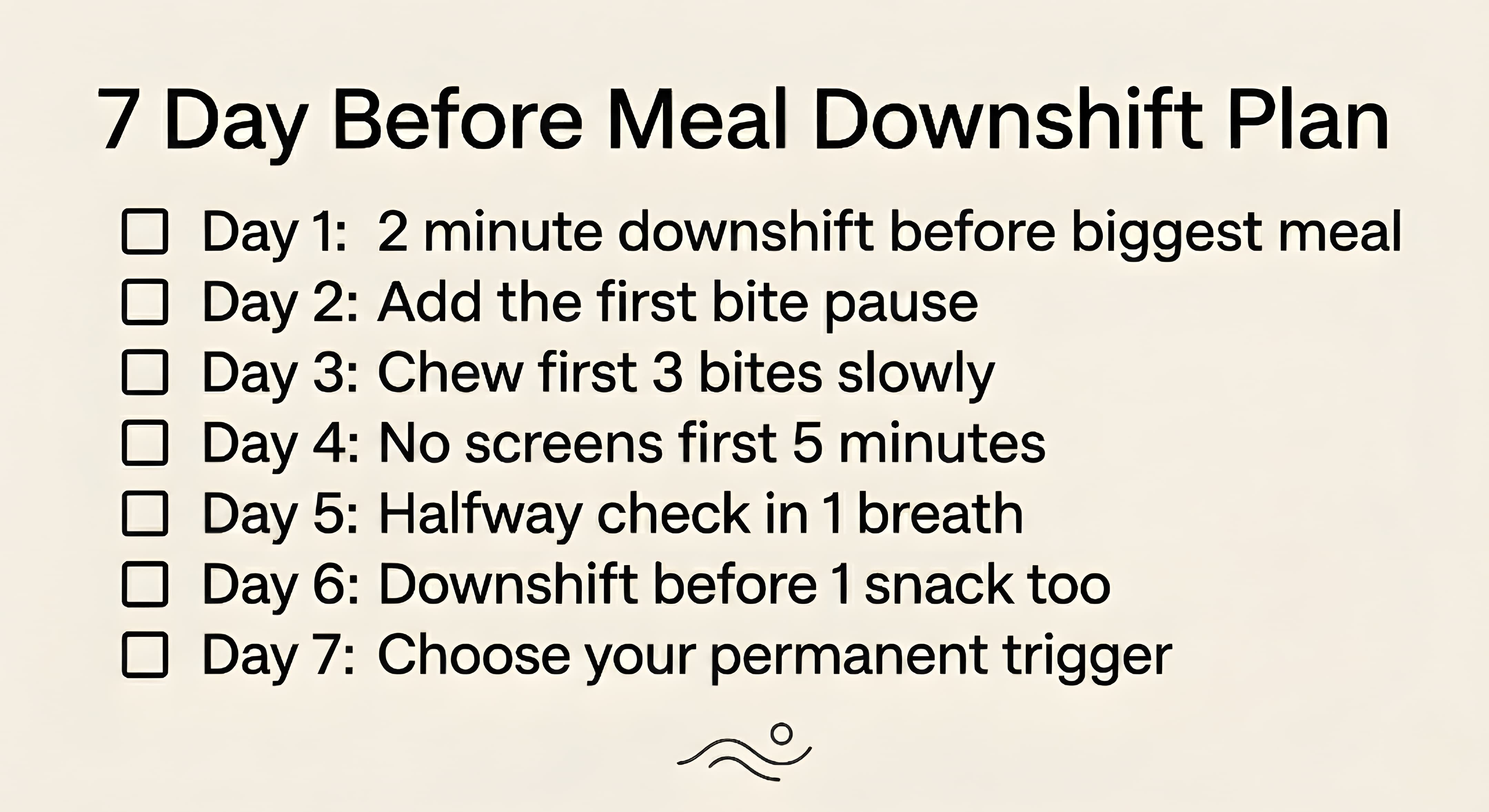
- Day 1: Do the 2 minute downshift before your biggest meal.
- Day 2: Add the first bite pause.
- Day 3: Chew your first three bites slowly.
- Day 4: Remove screens for the first five minutes of the meal.
- Day 5: Add a mid meal check in at the half point.
- Day 6: Do the downshift before one snack too.
- Day 7: Choose your permanent trigger and keep it going.
Mid meal check in question:
"Am I still hungry, or am I just continuing because I am distracted or stressed?"
No judgment. Just notice.
Make this feel clearly connected to digestion
To keep this routine grounded in gut comfort, pair it with one simple digestion friendly habit. This creates a repeatable mini system instead of a standalone trick.

- Add fiber to breakfast, then do the downshift before lunch.
- Add one fermented food serving, then do the downshift before dinner.
- Drink water earlier in the day, then do the downshift before your meal.
- Do a 10 minute walk after meals, and use the downshift before meals.
If you want a full set of gut habits with a clear weekly structure, this guide pairs perfectly with: Daily Gut Health Habits
Optional: make it easier with simple tools
You can do this with no tools. Tools just reduce friction. Keep it optional. Your breathing routine is still the foundation.
Timer
Set a 2 minute timer and breathe with a longer exhale until it ends.
Visual breath pacer
Some people stay consistent better when they follow a moving circle or wave.
Short guided audio
If you prefer being guided so you do not have to count, a short audio cue can lead you through a longer exhale rhythm.
If you want to explore an audio based option, you can read my breakdown here: The Genius Wave Review

Safety notes
This should feel steady and comfortable. Stop if you feel dizzy, lightheaded, or panicky. Return to normal breathing.
- Inhale 4 seconds
- Exhale 4 or 5 seconds
- Do fewer cycles
The goal is calm, not strain.
The simplest version to remember

FAQ
Does breathing before meals help digestion?
It can support a calmer meal start, which often helps with pacing and awareness. Many people find that slowing down and reducing stress before eating improves comfort. It is not a cure, but it is a practical habit.
How long should I do it?
Start with 2 minutes before one meal per day for 7 days. Then keep it before your biggest meal or expand it to more meals if it helps.
What if I cannot do a 6 second exhale?
Use a 5 second exhale, or use the 60 second version. A longer exhale than inhale is the key idea.
What if counting makes me anxious?
Do not count. Just make your exhale longer and slower than your inhale for about 6 to 10 breaths.
Should I do this before snacks too?
Yes, especially if you stress snack. Try 60 seconds before one snack per day for a week and see if it changes your urge to rush or graze.
Can this help with bloating?
Bloating has many causes. This may help indirectly by slowing eating and reducing stress driven swallowing of air. If bloating is frequent or severe, medical guidance matters.
Is this safe for everyone?
Most people can do gentle slow breathing, but if breath focus triggers anxiety, dizziness, or discomfort, stop and use a simpler approach like one slow exhale before the first bite.
How soon will I notice results?
Many people notice a small shift immediately, like less urgency to eat. Bigger benefits come from doing it consistently for a week or two.
Next step: your simple daily routine
Copy this into your notes if you want the easiest way to start.
Daily Checklist
- Sit and ground your feet
- Rest one hand on your belly
- Inhale for 4 seconds
- Exhale for 6 seconds
- Repeat for 10 cycles
- Take one normal breath
- Make the first bite slow
Tip: Save this guide and revisit it after 7 days to adjust what’s working.