Where should you start?
If everything feels urgent, choose by the problem you notice most often:
| When your day feels like... | Start with... |
|---|---|
| You wake tired and stay tired | Sleep, then screen boundaries |
| You forget to eat or drink until afternoon | Water and a more complete meal |
| You sit for hours and feel restless | Movement, stretching, or breaks |
| Your mind never seems to stop | Breathing, journaling, or fresh air |
| Your routine feels joyless | Small wins and fun |
You can choose only one. If you already have a health condition, a physical limitation, or instructions from a clinician that affect sleep, fluids, food, exercise, or cold exposure, adapt these ideas to that advice.
Build the foundations
1. Give sleep enough room
Most adults need at least seven hours of sleep, although the exact amount varies by age and person. The most useful first move is often not a complicated nighttime ritual; it is making enough time for sleep and keeping your wake time reasonably steady. If you must get up at 6:30 a.m., a midnight bedtime cannot routinely deliver eight hours, however good your pillows are. Sleep quality matters too, and persistent sleep problems are worth getting help for.
Pick one dependable cue: dim the lights after dinner, set a reminder to begin winding down, or move the phone charger away from the bed. If you work shifts, a consistent schedule may be difficult; focus on protecting a realistic sleep window and making the room dark and quiet when you can. One late night does not ruin the routine. Return to your next sensible bedtime rather than trying to compensate with a perfect reset.
Make it workable
Start the wind-down 20 minutes earlier three nights this week. Use that time to prepare tomorrow's bag, wash up, and read a few pages, so bedtime does not begin with another list of chores.
2. Make drinking water easy to remember
A fixed two-litre rule sounds simple but ignores body size, food, activity, climate, and individual medical advice. Six to eight cups or glasses of fluid a day is a common general guide; other drinks and food contribute, and needs rise in heat and with prolonged activity. You do not need to chase a bottle target late at night.
Instead, put drinking where it already fits. Have a glass when you make breakfast, take water with lunch, and refill before leaving home. If plain water is unappealing, try sparkling water, sliced citrus, or unsweetened tea. If you tend to forget, a visible glass at your desk may work better than an app that sends notifications you ignore.
Make it workable
Before opening your laptop, fill a glass and place it where you will see it. Finish and refill it when you take lunch. That is a cue you can repeat without counting every sip.
3. Move your body in a way you can repeat
Thirty minutes is a useful example, not a daily pass/fail test. Adults are generally advised to aim for at least 150 minutes of moderate activity across a week, with muscle-strengthening activity on two days. That might be a half-hour walk on five days, a bike ride on the weekend plus shorter walks, or several small sessions. Some activity is better than none.
Choose the movement that survives contact with your schedule. A parent might walk while a child is at practice. A desk worker might dance through two songs after closing their laptop. A person with limited mobility might use a seated routine appropriate for them. The test is whether you are willing and able to do it again next week, not whether it looks like a workout online.
Make it workable
Put a ten-minute movement block next to something that already happens, such as lunch or the commute home. Add time only when the smaller block feels natural.
4. Make whole foods the easy part of a meal
“Eat whole foods” can become vague or expensive advice. A more useful question is: What could I add to this meal that makes it more satisfying? Keep the food you enjoy, then add a fruit or vegetable, a source of protein, or a whole grain or bean. Frozen vegetables, canned beans, oats, eggs, tofu, yogurt, and tinned fish can all make a quick meal more complete.
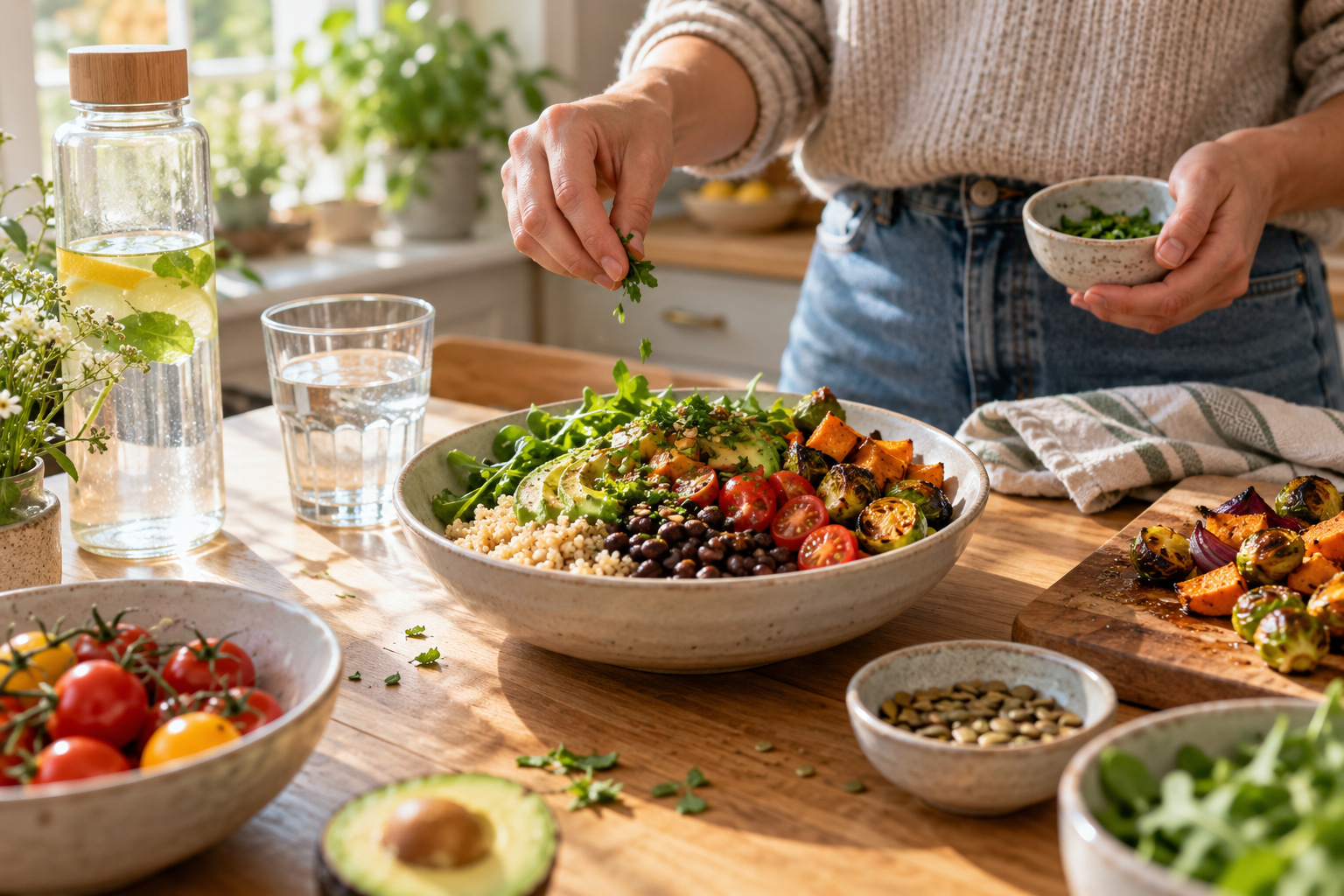
Take a rushed lunch of toast and call it a starting point, not a failure. Add hummus, sliced tomato, and a piece of fruit. For dinner, make a bowl from leftover rice, black beans, roasted vegetables, avocado, and a sauce you like. The point is to build meals that you actually want to eat and can assemble again. Packaged and convenient foods can be part of that system.
Make it workable
Choose one reliable meal and keep its ingredients on hand. Familiarity is often more useful than a folder of recipes you never cook.
Move more without turning the day into a workout
5. Use a step count as feedback, not a verdict
Walking is accessible to many people, but 10,000 steps is not a threshold you must cross to receive a benefit. Research has found benefits below that figure, and about 7,000 steps can be a meaningful, more achievable target for some adults. These are population findings, not a personal prescription.
If tracking helps, look at your usual average first. Someone averaging 3,500 steps may find a regular ten-minute walk more useful than staring at 10,000. Add a short errand on foot, walk one extra block, or take a phone call while moving. If step counting makes you anxious, skip the number and notice whether walking is becoming easier or more frequent.
Make it workable
Choose one repeatable walk. A 12-minute loop after lunch is a real habit even when the rest of the day stays busy.
6. Stretch the places your day keeps still
Stretching does not have to mean a long yoga session or trying to touch your toes. It can be a change of position. If you have been looking down at a screen, stand and reach your arms overhead. If you have been sitting, straighten one leg at a time and move your ankles. If you have been on your feet all day, sit down and gently move through your shoulders and back.
Move slowly and stay within a comfortable range. Stretching should not be sharp or painful, and a pose that suits someone else may not suit you. It is especially useful as a transition: before you start work, after the drive home, or while a kettle boils.
Make it workable
Attach a two-minute stretch to one existing cue, such as ending a meeting. Shoulders, neck, hips, and calves are a better menu than a rigid sequence you will abandon.

7. Try a short, comfortable breathing pause
Deep breathing is sometimes sold as a way to instantly fix stress. It is better thought of as a small pause that gives you a choice before your next action. Breathing is a common relaxation technique, although the evidence for treating specific conditions is limited.
Try this before opening a difficult email: set both feet on the floor, relax your jaw, and breathe in and out at an easy pace for five cycles. There is no need to hold your breath or force an unusually slow rhythm. If focusing on breathing feels uncomfortable, place your attention on the pressure of your feet against the floor instead.
Make it workable
Use the pause at a moment you already recognize: before a meeting, after a tense commute, or while waiting for the kettle. The cue matters more than a timer.
8. Step outside for a change of scene
Fresh air is not a cure-all, and you do not need a picturesque trail. Step onto a balcony, walk to the mailbox, or take lunch to a nearby bench. Notice the air temperature, one sound, and something in the distance. Changing where you look and how your body feels can mark a useful break from a room that has become all work or all worry.
If weather, air quality, safety, or mobility makes going outside impractical, open a window where appropriate or sit by one and let your eyes rest on a distant view. Make the habit fit your circumstances instead of turning it into another demand.
Make it workable
After a long indoor stretch, take a five-minute outdoor loop with no destination and no phone task. Come back when you are ready.
Make room for a calmer mind
9. Practice specific gratitude, without forcing positivity
Gratitude is most useful when it helps you notice something real; it becomes annoying when it asks you to pretend a hard day was wonderful. Name one specific thing that made today easier, kinder, or more interesting. “My friend sent the recipe I asked for” says more than “I am grateful for everything.” On a difficult day, “the bus came on time” is enough.
You can say it aloud, send a thank-you message, or simply make a mental note. No special journal is required. Let this habit sit beside frustration or sadness, not erase them.
Make it workable
At dinner or while brushing your teeth, finish this sentence: “One thing I appreciated today was…” Stop at one if that is all you have.

10. Spend some time in daylight
Daylight can give your day a clearer shape, particularly if you spend most of it indoors. Pair it with an errand, a walk, or a short break outside rather than scheduling a separate “sunlight session.” If mornings are rushed, even walking part of your usual route outdoors is more realistic than a ritual that depends on an empty calendar. Light also helps regulate your sleep-wake cycle.
The goal is daylight, not sunbathing. You do not need ten minutes of direct sun on bare skin. Follow sun-safety guidance for the conditions where you live, including shade and protection when UV exposure is high.
Make it workable
Take the first suitable outdoor break of your day, even if it is just a short walk from your door and back.
11. Treat a cool rinse as optional, not essential
Some people enjoy ending a warm shower with 15 to 30 seconds of cooler water because it feels brisk and gives the shower a clear finish. If you are curious, turn the temperature down gradually, keep the water comfortable enough to breathe normally, and stop if you feel unwell. A cold plunge is not required, and there is no strong reason to put it ahead of sleep, food, or movement.
Research on cold-water exposure is still limited, its longer-term effects are uncertain, and cold can raise heart rate and blood pressure acutely. If you have a heart or circulation condition, fainting history, or another reason cold exposure may be unsafe, skip this one or ask a clinician who knows your situation.
Make it workable
If you dislike it, drop it. A pleasant warm shower that helps you transition into the day is already useful.
12. Put a boundary around screen time that matters
“Limit screen time” is too broad when your job, maps, friends, and banking all live on screens. Identify one stretch of scrolling you would rather spend differently. Maybe it is the first ten minutes after waking, the phone at the dinner table, or the last half-hour before bed. Changing that one moment gives the habit a reason.
Make the boundary physical. Leave the phone charging in another room while you eat. Move the most tempting app off the home screen. Set a book beside your pillow before evening arrives. Late-night bright light can interfere with sleep timing for some people, so a quieter hour before bed can help. There is no need to label every useful minute on a device as bad.
Make it workable
Choose a 20-minute window that has an obvious alternative, such as a meal, a call, a shower, or reading.

13. Journal to clear a little space, not to write beautifully
An empty notebook can feel like homework. Give the page a job. If you are worried, write down the next action you can take and what can wait. If you are overloaded, list what is competing for your attention. If you want to remember a good day, record one detail: the conversation, the meal, the view from the train.
Three sentences can be enough: “What is on my mind? What is one thing I can do? What can I leave for later?” A note on your phone works too. This is a place to put thoughts, not a performance of insight.
Make it workable
Keep the notebook where you already pause: beside the bed, at the kitchen table, or in your work bag. Use it when it serves you; a missed day requires no catch-up entry.
Protect time for recovery and enjoyment
14. Take breaks before you are completely spent
Breaks often disappear because they sound like time away from the “real” task. In practice, a short change of posture, view, or pace can help you return with more attention. Stand up between calls, walk to refill your water, or step away after finishing a draft. You do not have to earn a break by becoming exhausted first.
Choose a break that actually changes something. Switching from a work tab to a social feed may keep your eyes and mind in the same mode. Washing a cup, getting fresh air, stretching, or sitting quietly for a few minutes can feel more distinct. If your work does not allow regular breaks, look for one realistic pause you control rather than an ideal schedule that ignores your job.
Make it workable
After one natural stopping point, take a three-minute break away from the screen before starting the next task.
15. Notice small wins while they are happening
“Celebrate small wins” does not mean throwing a party because you answered an email. It means giving a completed effort its proper size. You prepared lunch despite a crowded morning. You went to bed earlier twice. You returned to a walk after missing a week. Recognizing that progress makes a habit easier to see and repeat.
Be specific about what worked: “I kept my shoes by the door, so I walked before dinner.” That sentence tells you more than a vague “good job.” It also reveals a system you can keep. When a plan fails, use the same curiosity: was the goal too large, the cue poorly timed, or the day genuinely full?
Make it workable
At the end of the week, write down one thing you did and one reason it was possible. Let that guide next week's plan.
16. Make time for fun that has no productivity goal
Fun is not a reward for finishing every obligation. It is part of a life you want to keep showing up for. Invite a friend for a walk where neither of you tracks the route. Make a ridiculous playlist for cooking. Visit the library and choose a book by its cover. Play a game, draw badly, or try a new café without turning it into content.
The best version is personal. If you love hosting, put soup and bread on the table and ask people over. If you need solitude, reserve an hour for a hobby you are allowed to be average at. A routine that leaves no space for pleasure will be hard to sustain, however carefully it is planned.
Make it workable
Put one enjoyable thing on the calendar this week. It can be brief and free; the important part is that it is something you actually want to do.
What a realistic week can look like
These habits work better as a menu than as a 16-box tracker. Here are two ways to put them together.
A crowded workweek
On Sunday, Maya buys yogurt, oats, frozen berries, and ingredients for two bean bowls. She fills a water bottle before work, takes a ten-minute walk after lunch on three days, and leaves her phone charging across the room at bedtime. On Thursday, work runs late. She skips the walk, eats a convenient dinner, and keeps the sleep window she can manage. The routine still exists on Friday.
An irregular schedule
Jordan's shifts change each week, so a fixed 7 a.m. routine would fail immediately. They protect a dark, quiet sleep period after each shift, bring a filling meal and water to work, stretch on breaks when possible, and call a friend on the ride home. They use daylight when their schedule allows and do not chase a step goal after a long shift.
Start your own week
Choose one foundation habit and one habit that makes the day feel better. Make each one specific: “Take water to lunch” and “read in bed for ten minutes” are easier to act on than “be healthier.” After a week, keep what helped, shrink what was too ambitious, and let the rest wait.
A final thought
Wellness is easier to live with when the habits support your day instead of competing with it. A good week might include a longer walk and home-cooked meals. Another might include extra sleep, a glass of water by the bed, and five quiet minutes. Both can move you toward a steadier routine. Choose one useful next step and make room for it in the life you already have.
FAQ
Do I need to do all 16 habits every day?
No. Sleep, food, fluids, and movement are ongoing needs, but the exact form varies by day. Gratitude, journaling, a cool rinse, or a planned fun activity can be occasional tools. Choose what fits your life and repeat the parts that help.
Is 10,000 steps necessary for health?
No. Research shows benefits below 10,000 steps. Your starting point, mobility, and schedule matter. If walking is appropriate for you, a sustainable increase from your usual level can be a more useful goal than a universal number.
Do I have to drink two litres of water?
No. Fluid needs vary, and drinks other than water and some foods contribute. Drink regularly and pay attention to heat, activity, thirst, and any advice you have received for a medical condition.
Which habit should I start with if I am exhausted?
Start by looking at sleep opportunity and whether you are eating and drinking regularly. Keep the first action small, such as an earlier wind-down or a prepared breakfast. Persistent or unexplained fatigue deserves a conversation with a healthcare professional.
How long does it take to build a wellness habit?
There is no universal deadline. A habit gets easier when its cue is obvious, the action fits your day, and you repeat it often enough to learn from it. Judge the first week by whether the plan was realistic, not by an arbitrary streak.
Keep Going
-
-